Curriculum & Assessment
Experience Curriculum:
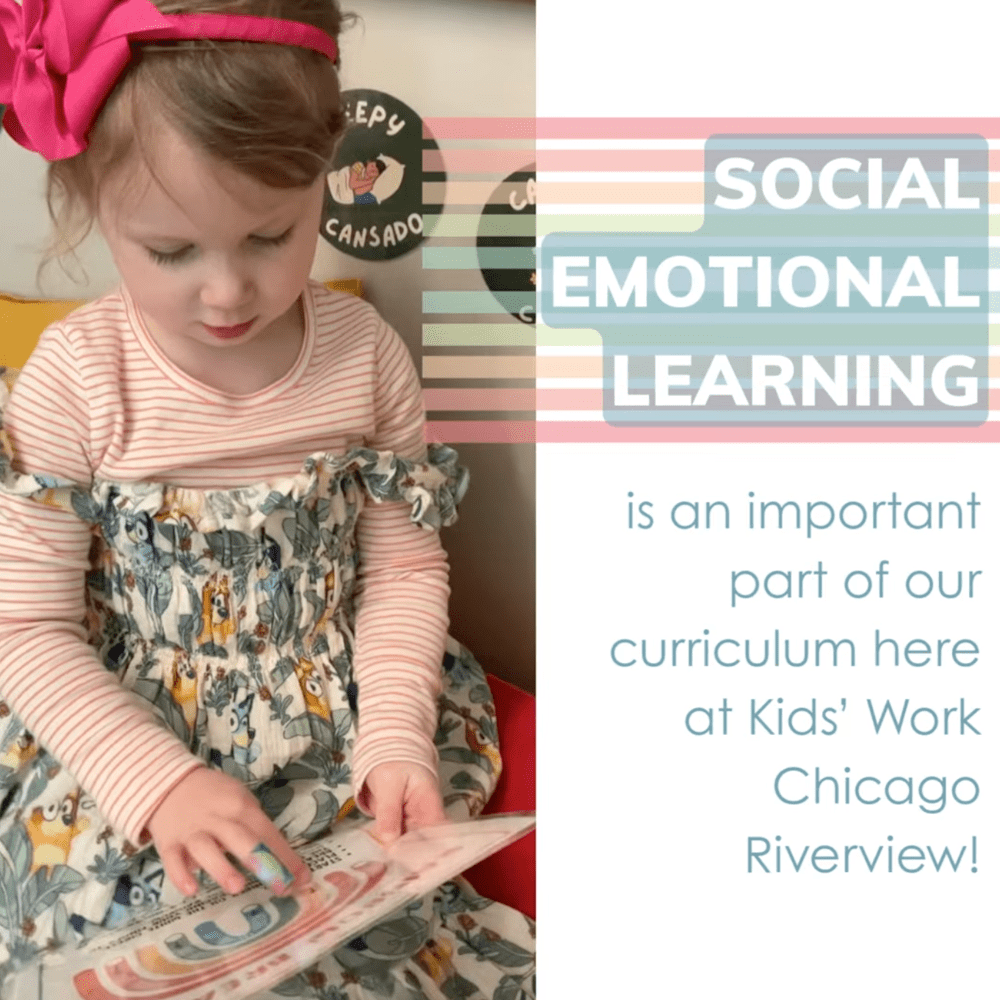
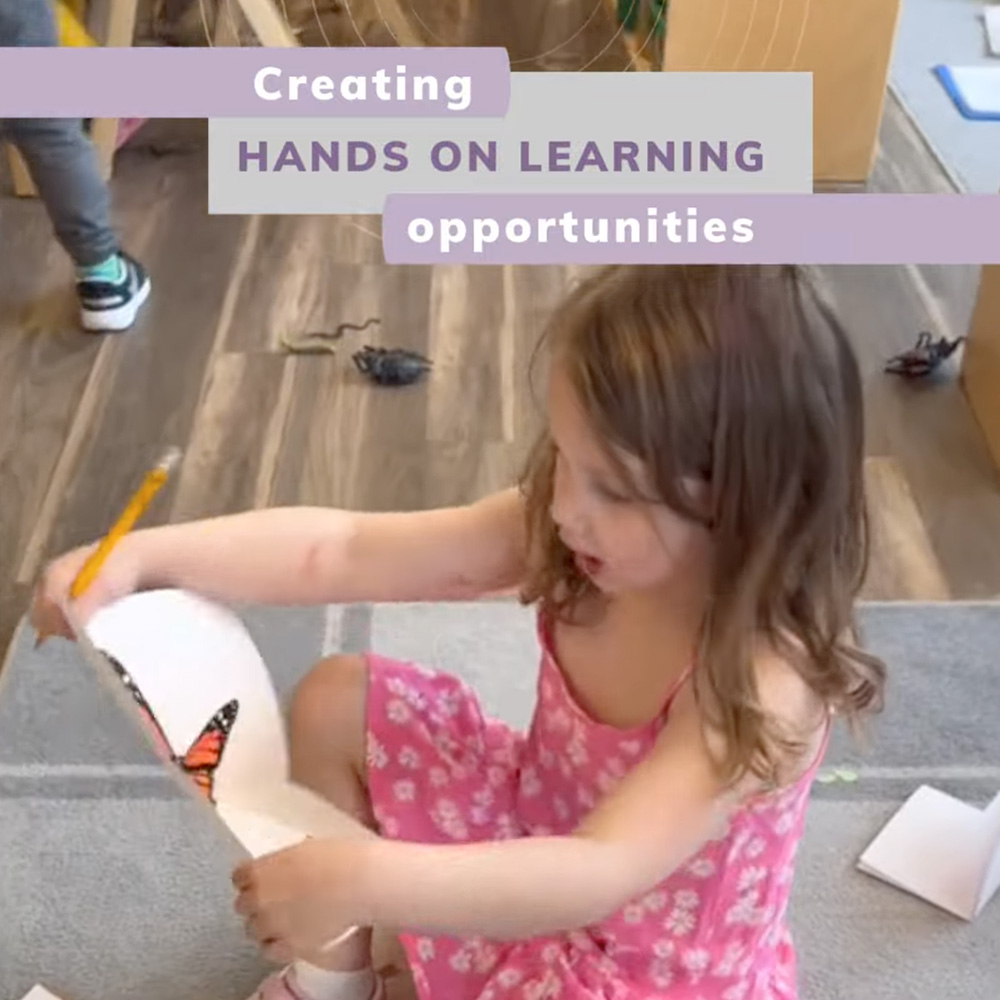
Here at Kids’ Work Chicago Riverview, we believe that utilizing a quality curriculum provides students of all ages with daily experiences that develop their growth and allow them to reach their potential. We incorporate the Experience Early Learning Assessment and Curriculum System to build classrooms that are in tune with each child’s unique learning journey and nurture them through hands-on exploration, play prompts, interaction with art, music, and drama, and social emotional learning. We love how seamlessly the curriculum pairs with the Brightwheel App, giving parents easy access to lesson plans and the ability to see their child engaging in activities, as well as daily assessment observations.

The Kids’ Work Curriculum Approach:
While we use the Experience curriculum as the base of our learning and assessment framework, we acknowledge that each classroom is unique. Classes have freedom to organize their own process based art & open ended sensory activities each week. Additionally, they may modify activities by using different materials or themes to engage their students. Experience themes span the entire month and delve into new sub-topics each week, but teachers may also add in an additional subject that is relevant to that time such as Hispanic Heritage Month or other cultures/holidays/events. More experienced and advanced teachers may modify the lesson plan structure but will always retain a focus on nurturing all skills and will complete daily assessments on specific skills.
The Assessment Process: Daily Observations:
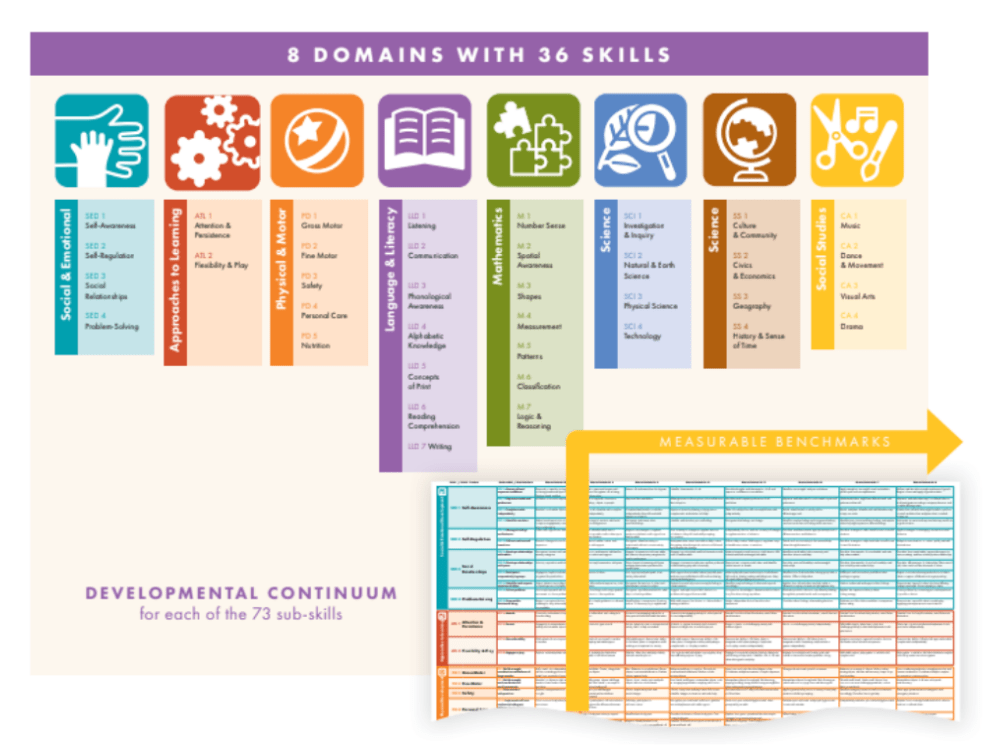
The Experience Curriculum is organized through 8 main domains, cumulatively covering 36 skills, with 73 sub-skills, all meeting state learning standards.Each day, teachers gather authentic data through targeted activities as well as natural observation. This allows teachers to scaffold experiences to support children from learning to development. When looking at the observations for your child, you will also see individual benchmarks listed.
Feel free to consult the Experience Developmental Continuum of Skills for a
more detailed visual of growth.
Please note that observations are used to guide learning and screen growth, and are not a formal diagnosis.
Daily Lesson Plan Activities & Observations:
Utilizing the Brightwheel App, parents can easily see the curriculum activities planned for each day, see additional learning details, play songs from the curriculum, and see teacher observations and assessment benchmarks! View the video for a helpful tutorial!
Curriculum and Assessment in the Infant
Classrooms
(6 week- 15 month old students):
* Benchmark Ranges:
Benchmarks 1–2 apply to children ages 3–18 months. Since our infants transition to the toddler classroom at around 15 months, it’s expected that they will not reach all benchmark 2 goals before moving up. The continuum is designed to scaffold skills as children grow.
* About “0” Benchmarks:
It is completely normal for infants to have a 0 in certain benchmarks. Each child develops at their own pace, and benchmarks are a guide, not a test. For example, skill PD1 “Builds strength, coordination, and balance of large muscles,” benchmark 1 is that a baby rolls, crawls, sits independently and pulls self into a standing position. It will take a baby time to develop all of these skills, a child will have a benchmark of 0 while still mastering these steps, this simply shows what they’re working toward. Teachers will always discuss any developmental concerns directly with parents.
* Daily Assessment:
Classroom activities are designed to nurture skills within the continuum. However, infants may sometimes choose not to participate, and that’s perfectly okay. Teachers use observations throughout the day to capture growth and progress in authentic ways.
* Our Approach:
Every child’s learning path is unique. Our teachers build strong, loving connections with each infant, creating a safe, nurturing space where they can grow and thrive at their own pace.
Curriculum and Assessment in the Toddler/Twos
Classrooms
(15-36 month old students):
* Benchmark Ranges:
Benchmarks 1–3 tend to apply to children ages 15–36 months. Since the Experience
Toddler curriculum begins at 18 months, teachers scaffold activities and benchmarks
down to meet the needs of our younger toddlers (15–18 months) which is why you may
see benchmark 1 for this age group.
* About Benchmark Growth:
It is completely normal for children to remain at the same benchmark for a while.
Each child develops at their own pace, and benchmarks are a guide, not a test.
For example, skill SED 4a “Solves Problems” benchmark 3 is that a child
“Recognizes a problem AND asks for adult help to solve the problem.” It will take
time for a child to develop both of these skills, so they will remain at benchmark 2
while still mastering these steps, this simply shows what they’re working toward.
Teachers will always discuss any developmental concerns directly with parents.
* Daily Assessment:
Classroom activities are designed to nurture skills within the continuum. However,
toddlers may sometimes choose not to participate, and that’s perfectly okay.
Teachers use observations throughout the day to capture growth and progress
in authentic ways.
* Our Approach:
Toddlers and Two Year Old students require a lot of flexibility and scaffolding in their learning! We value each child’s unique learning path and work to support all students through a strong, loving connection in a safe and dynamic classroom.
Curriculum and Assessment in the Preschool
Classrooms
(3-4 year old students):
* Benchmark Ranges:
Benchmarks 3–5 tend to apply to children ages 3–4 years with most children likely falling in benchmark 4 for many areas.
* About Benchmark Growth:
Development always occurs at each child’s unique pace and it is completely normal for a child to stay at the same benchmark for a while. Benchmarks are a guide, not a test, and all parts of a benchmark must be observed for the child to reach that level. For example, skill LLD 4 “Identifies letters, makes letter-sound connections and decodes words” benchmark 4 is that a child “Identifies five to ten upper and lowercase letters and letter sounds.” It will take time for a child to develop both of these skills, so they will remain at benchmark 3 while still mastering these steps, this simply shows what they’re working toward. Teachers will always discuss any developmental concerns directly with parents.
* Daily Assessment:
We honor each child’s choice to participate in activities. If a child isn’t interested in the activity used for the day’s assessment, teachers use observations throughout the day to capture the child’s growth and progress, and the child’s skills will still be logged.
* Our Approach:
Preschool students are so excited to learn and build independence! Teachers work to connect with each student, so they feel valued and loved, and teacher scaffold activities to support their growth and mastery in more complex skills!
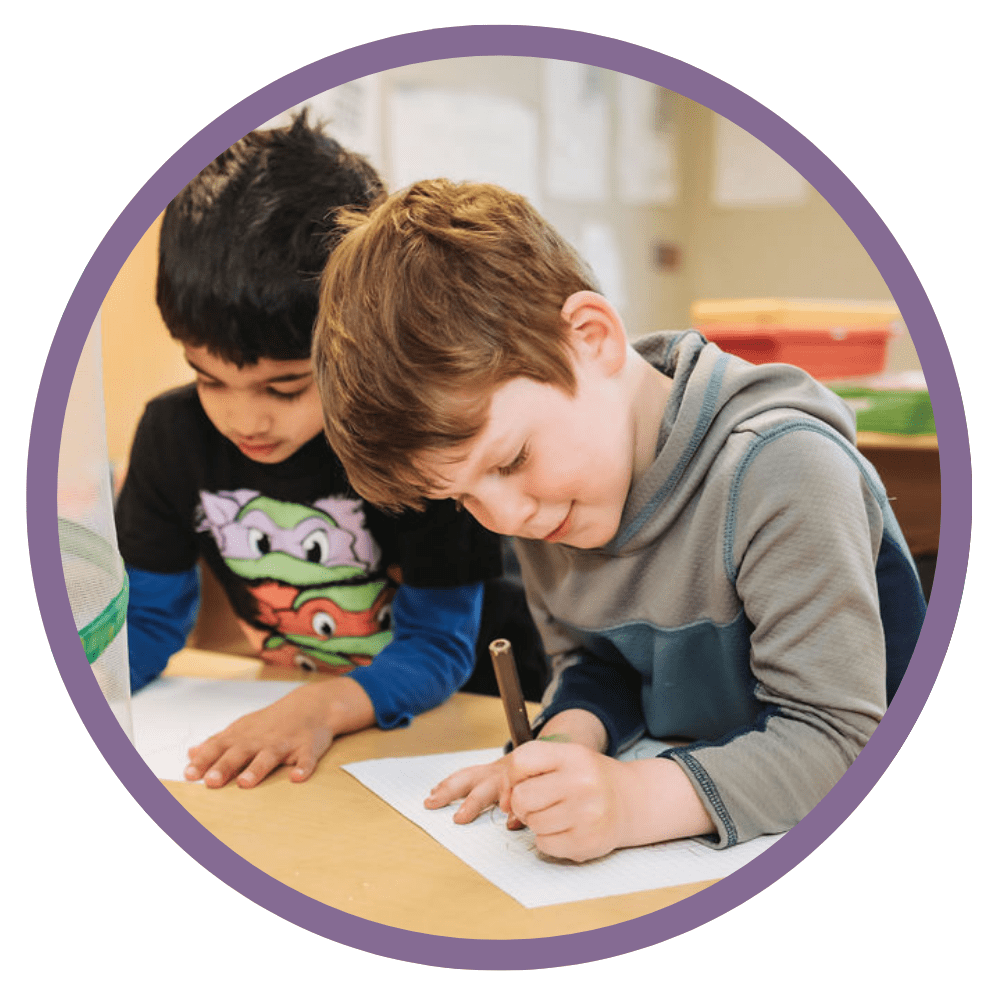
Curriculum and Assessment in our Jr. Kindergarten
Classroom
(4-5 year old students):
* Benchmark Ranges:
Benchmarks 4–6 tend to apply to children ages 4–5 years with most children likely falling in benchmark 5 for many areas.
* About Benchmark Growth:
Development always occurs at each child’s unique pace and it is completely normal for a child to stay at the same benchmark for a while. Benchmarks are a guide, not a test, and all parts of a benchmark must be observed for the child to reach that level. For example, skill LLD 4 “Identifies letters, makes letter-sound connections and decodes words” benchmark 6 is that a child “Identifies all upper- and lowercase letters AND letter sounds.” It will take time for a child to develop both of these skills, so they will remain at benchmark 4 while still mastering these steps, this simply shows what they’re working toward. Since the 6 benchmark falls under the “Primary” heading, a child may not master that skill until they graduate to elementary school, which is absolutely fine. Teachers will always discuss any developmental concerns directly with parents.
* Curriculum Activities:
We honor each child’s choice to participate in activities. If a child isn’t interested in the activity used for the day’s assessment, teachers use observations throughout the day to capture the child’s growth and progress, and the child’s skills will still be logged.
* Our Approach:
Our Jr. Kindergarten classroom is designed to ensure that students are Elementary School ready. Our highly qualified teacher, Ms. Abby, utilizes the Experience Continuum of Skills in her daily assessment, and also incorporates UFLI curriculum and concepts from Learning Without Tears to add depth to her instruction.